
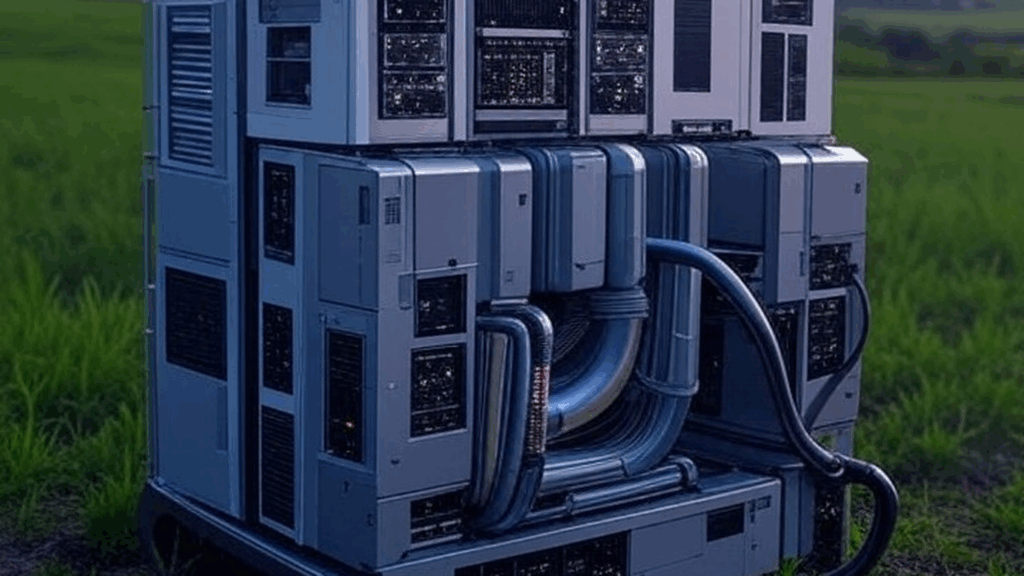
NVIDIA turns DGX SuperPOD into a “Rubin-era” AI factory blueprint
NVIDIA announced the Rubin platform and new DGX SuperPOD designs that bundle Rubin GPUs, Vera CPUs, NVLink, DPUs, SuperNICs, and switches into tightly integrated AI “factories.”
Rubin-based DGX SuperPODs will ship in the second half of the year, with both NVLink-dense Vera Rubin NVL72 racks and more traditional x86-based Rubin NVL8 systems.
This is NVIDIA doubling down on vertical integration of the AI data center stack.
Rubin is not just a GPU refresh. It is a full platform recipe: CPU, GPU, NIC, DPU, switch, interconnect, and orchestration software all tuned together around AI training and inference economics.
Key points for infrastructure teams:
DGX as a reference architecture, not just a box
SuperPOD has always been NVIDIA’s “this is how you should build it” pattern. Rubin pushes that further.
The Vera Rubin NVL72 design treats an entire rack as a single GPU system with unified memory and heavy NVLink bandwidth. That kills a lot of painful model partitioning work, but it locks you into a very specific topology and vendor story.
Network is now part of the GPU story
The move to 800 Gb/s end-to-end and the explicit “two paths” (InfiniBand and Ethernet with Spectrum-6) is NVIDIA saying: if you want massive clusters, you buy our network too.
For practitioners, this is a warning: decoupling compute and network vendors will get harder at the high end. The congestion-control and performance-isolation features will be optimized for NVIDIA-on-NVIDIA first.
Designed for gigawatt-class AI factories
NVIDIA talks explicitly about “gigawatt AI factories.” That is not marketing fluff for operators.
At that scale, network-level congestion control and host offload via DPUs become survival tools, not nice-to-haves. Power and cooling envelopes are now a first-class design constraint for the platform, which sets expectations for how aggressive these systems will be in density and thermal load.
Liquid cooling is going mainstream, not niche
The Rubin NVL8 is a liquid-cooled x86 system pitched as the “on-ramp” to Rubin. That is NVIDIA normalizing liquid cooling for enterprises, not just hyperscalers.
For data center operators, this accelerates the timeline where rear-door heat exchangers and direct liquid cooling are table stakes for AI, not special projects.
Mission Control is about owning operations, not just hardware
NVIDIA Mission Control for Rubin is important. It moves NVIDIA from “we sell gear” to “we orchestrate your AI plant.”
Integration with facilities, power, and cooling, plus leak detection and autonomous recovery, starts to displace traditional DCIM and some cluster management roles. This bends the stack toward a NVIDIA-centric operations model, especially in greenfield AI builds.
Token cost is the real battleground
Rubin is explicitly sold as a 10x reduction in inference token cost versus prior gen. That is what CIOs and CFOs care about: cost per token, not TOPS.
It also acknowledges that inference on giant context, long-reasoning models will dominate GPU time. This shifts design from “big training clusters only” to “persistent AI factories that run hot on inference 24×7.”
The Big Picture:
AI hardware arms race and supply chain
Rubin-based DGX SuperPOD is NVIDIA’s latest anchor product to maintain GPU and system dominance.
By tying Rubin GPUs to Vera CPUs, SuperNICs, BlueField-4, and Spectrum/Quantum switches, NVIDIA increases switching costs. Once you buy into this pattern, swapping out a single layer (like the switch vendor or NIC vendor) becomes hard. That helps NVIDIA keep control of high-value, high-margin infrastructure.
Neoclouds and sovereign AI builds
These SuperPOD blueprints are exactly what neoclouds, telcos, and sovereign AI programs will buy and rebrand as “national AI clusters” or specialized AI services.
Rubin-based SuperPOD plus NVIDIA AI Enterprise and NIM microservices is essentially a prepackaged “NVIDIA cloud-in-a-rack” offering. That makes it easier for countries and enterprises to stand up AI capacity outside the big three hyperscalers, while still being tied to NVIDIA’s ecosystem. Both CoreWeave and Nebius have already announced their future deployments.
GPU scarcity and differentiation
Rubin’s message is: when you finally get GPUs, they will be wired in a way that maximizes NVIDIA’s value.
Unified NVLink racks, heavy use of DPUs, and integrated orchestration create strong technical arguments to keep workloads on NVIDIA reference designs rather than on DIY clusters or alternative accelerators. This makes it tougher for AMD, Intel, and emerging accelerator vendors to compete at the “AI factory” scale, even if they have good chips.
Data center buildout, power, and cooling
Targeting “gigawatt AI factories” reinforces that the next phase of AI buildout is less about individual rooms and more about campus-scale, power-constrained sites.
Rubin’s design and Mission Control’s focus on power events and cooling optimization are a response to actual grid and thermal limits. This will increase the divide between sites that can support Rubin-class density with liquid cooling and power envelopes, and legacy colo and enterprise sites that cannot, which will be pushed to smaller NVL8-style deployments or to cloud/neocloud providers.
Enterprise AI adoption and cloud repatriation
Rubin-powered SuperPODs plus NIM and AI Enterprise give large enterprises a credible path to run frontier-scale and agentic AI on premises or in dedicated facilities.
For organizations with consistent, heavy AI loads, this strengthens the case for partial repatriation from public cloud to dedicated “AI factories” managed by internal teams or partners. Public cloud remains the burst and experimentation layer. The steady-state, expensive inference could migrate to Rubin-based clusters where token economics can be more tightly controlled.
Signal Strength: High
Source: NVIDIA DGX SuperPOD Sets the Stage for Rubin-Based Systems | NVIDIA Blog