
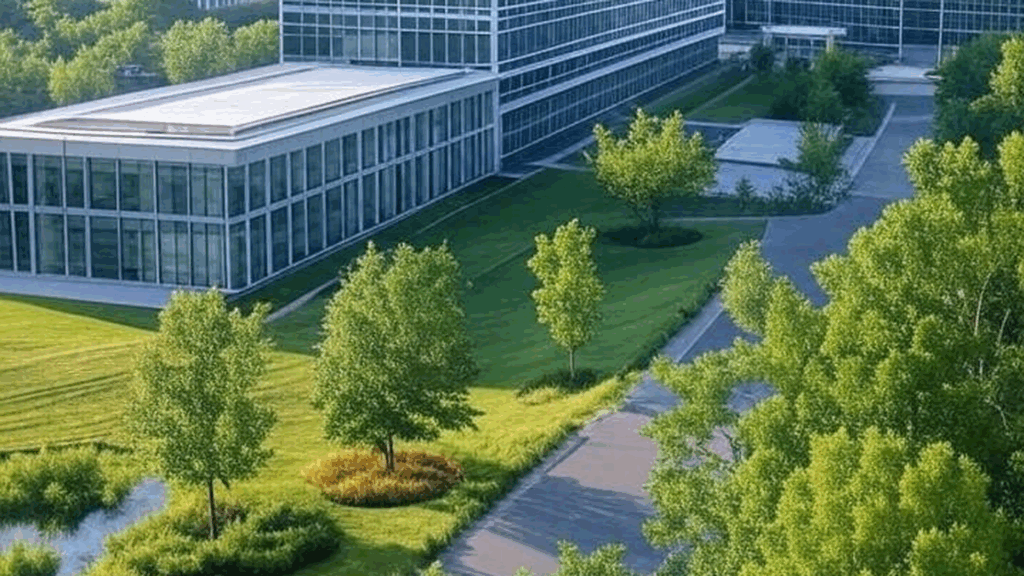
Massive AI compute projects aren’t coming online in anonymous server rooms anymore. They are arriving as AI campuses: hundreds of acres, grid-scale power contracts, and community approval risk stacked right alongside construction risk. One of the clearest examples of this is the OpenAI and Oracle joint infrastructure push that has recently unfolded in Saline Township.
To understand where hyperscale AI is headed, it helps to look at where it’s already hitting friction today. The planned AI campus, frequently referred to in media coverage simply as “Stargate,” has sparked a collision between utility fast-tracks, farmland conversion, litigation, public trust, and state-level political backing. None of these dynamics live cleanly inside a single category. They overlap. And they are about to become the new baseline for deploying large AI infrastructure in North America.
From abstract backlash to hard, local questions
For years I thought of community pushback on data centers as something that happened around a project, not insideproject risk. But that line has blurred. Resistance isn’t abstract outrage against “big buildings full of servers” anymore. It is targeted and specific. Residents in Saline are protesting opaque agreements around who gets the power, how much water is involved, and what happens to local rates long-term. This type of backlash is loud, organized, and far more sophisticated than traditional NIMBY rhetoric.
What’s fascinating is the shift in language. The Saline project is officially branded a “hyperscale data center.” But parallel research compute work is being called a high performance computing center instead. Labels are being used to steer public reception almost as much as CapEx size or actual engineering footprint. How you name infrastructure is starting to change how communities respond to it.
What actually changed in AI data-center design?
Land
The Saline AI campus is planned as a multi-billion dollar facility that sits on hundreds of acres of converted farmland. This is no small plot tucked into an industrial park. It is a clear, hyperscale campus that needed rezoning—and initially failed to receive it. The township said no. And then the developer chose litigation over concession.
Power
If I could capture a single takeaway for operators, it’s this: utility contracts are no longer background dependencies, they are primary project accelerants and project flashpoints. A $7B AI campus isn’t financed like legacy colocation. It needs gigawatt-scale, long-term power supply contracts. Those contracts are being requested, and in some cases being approved, without public hearings. Spoiler: communities do not love that.
Compute concentration
This project is being framed as the largest economic infrastructure deployment in Michigan’s history, complete with a target of distributing more than 4 gigawatts of AI compute supply. This is cloud compute for two named tenants: OpenAI and Oracle. This isn’t a generically divided data-center floor. This is GPU-dense compute funded by one pair of companies in one region, inside one economic envelope.
Storage and networking gaps
None of the media sources take time to explain storage or fiber architecture. Which means local residents are being asked to accept grid-scale power load, farmland conversion, and utilities fast-tracking approvals while being left to guess how much fiber trenching, backhaul, rights-of-way impact, or storage clustering is involved.
From an operator perspective, what’s new isn’t that storage is being invented here. It’s that regional concentration risk for AI training workloads is being built into one massive, replumbed region. That shift alone introduces questions around resiliency, regulatory scrutiny, and future expansion rights.
Cooling
It’s easy to get distracted by cooling tech splatter (yes, I love liquid-to-chip too), but what communities actually respond to is simpler than coolant chemistry: water usage, air discharge, land impact, and thermal policy optics. And you can already hear it in public quotes: environmental scrutiny, water supply concern, grid reliability doubts. These are the pressure points that drive redesign conversations far faster than any spec sheet about a CDU or cold aisle ever will.
The approval path was zoning → lawsuit → settlement, not vote → handshake → build
The project didn’t just need approval from the community. It needed approval despite the community saying no. The rezoning request was rejected early on by Saline Township officials. After that rejection, the developer and landowners opted for a lawsuit. And that lawsuit turned into a settlement that allowed the project to proceed anyway.
This escalation path, resistance into litigation, litigation into settlement, settlement into go-ahead—is about to be the playbook. And it’s one that operators need to understand earlier, and buyers need to understand before contracting workloads to any single region.
Why it matters for operators and buyers
When I talk to infrastructure operators and enterprise buyers, the questions I care about most are the ones that impact delivery timelines, riser constraints, utility dependencies, and long-wave operational risk. And hyperscale AI builds like the Saline project are showing us that engineering, regulation, and trust negotiations are now one inseparable Venn diagram.
The project is being backed publicly by Gretchen Whitmer as an economic win, which gives it state-level political cover. But local residents are organizing protests around “no secret deals,” transparency, grid stress, and process legitimacy. That means opposition isn’t friction, it is a once-per-phase approval vehicle in itself, and a determinant of runway risk.
DTE, Michigan’s regional utility provider, has already attempted to fast-track power contract approvals for this AI campus via a special contract with an Oracle subsidiary, bypassing public hearings. Operators should pay attention here because how Michigan’s utility regulators handle these ex-parte requests will influence how fast multi-GW AI facilities can be approved elsewhere across North America.
For buyers evaluating where to place workloads, I can’t emphasize this enough: utility dynamics are now first-class infrastructure selection criteria. It’s no longer enough to love a cloud region for its fiber, price, or distance from your office. You have to understand its power politics, its regulator optics, and its community trust capital before you ever drop a cluster there long-term.
Local trust isn’t a “soft risk.” It is a material one. Perceptions of back-room agreements or secret power contracts trigger reputational drag that can affect not only timelines, but future expansion rights—problematic for any operator assuming they can quietly increase the size of an AI campus in a region after it’s already been contested publicly.
Projects at this scale are being justified with community investments like $14M to fire departments, farmland preservation funds, and construction job incentives. That tells me that political incentives and community funds are being pulled into the total cost calculation for hyperscale AI siting, long before commissioning happens.
From a buyer’s perspective, consider this your permission slip to ask better questions before signing anything that anchors you to a single region:
- How reliable is the grid?
- How transparent are the approvals?
- Who pays for grid upgrades?
- How much farmland is being converted?
- What is the water impact?
- What are the long-haul connectivity dependencies?
- And how are labels being used to influence public perception?
I know this feels like a lot. But these are the non-obvious project constraints that determine whether hyperscale AI buildouts proceed with minimal resistance or maximal friction. Operators and buyers that internalize this early will leave guesswork behind, build faster, and ultimately deploy smarter.
Closing thought
AI isn’t reshaping infrastructure in the future. It’s happening right now. The only real question left is whether communities, utilities, and cloud operators are renegotiating these runways transparently, or whether litigation and settlements are becoming the new normalization for where critical compute will live. And for infrastructure leaders and buyers, that’s a question worth tracking closely.
Sources
OpenAI data center planned for farmland in Saline
Protesters in downtown Saline fight against nearby planned data center
Protesters rally against DTE’s attempt to fast-track OpenAI, Oracle data center – mlive.com